"In the face of a complex situation, we must not only clearly recognize challenges such as external volatility, the low-carbon transition, and insufficient high-end supply, but also actively seize opportunities like structural upgrading, technological revolution, and market expansion. We must respond to change with transformation and solve problems with innovation, laying a solid foundation for the high-quality development of the petrochemical industry during the 15th Five-Year Plan period," said Li Yunpeng, Party Committee Secretary and Chairman of the China Petroleum and Chemical Industry Federation (CPCIF), at the 2025 China International Petrochemical Conference held in Ningbo on October 24.
Themed "Decoding New Growth", the conference brought together numerous guests from government agencies, leading domestic and international enterprises, industry organizations, and think tanks. They explored how the petrochemical industry can adapt to a new stage, seize new opportunities, and accelerate high-quality growth amid profound shifts in the global economic landscape and the intertwined evolution of technology and energy revolutions.
Fu Xiangsheng, Deputy Party Committee Secretary and Vice Chairman of the CPCIF, chaired the event. He noted that in the past, centralized layout and investment in new projects represented new growth. However, under current global economic stagnation, weak demand, oversupply, and intensified "involution-style" competition, new growth must come from innovation-driven development of new quality productive forces, and from high-quality development through green and low-carbon transformation and high-end structural upgrading.
Huang Xurong, Deputy Director of the Zhejiang Provincial Department of Economy and Information Technology, pointed out that the petrochemical and chemical industry is the largest pillar industry in Zhejiang’s manufacturing sector. In 2024, the revenue of the province’s regulated petrochemical and chemical enterprises reached RMB 1.8 trillion, ranking third nationally. Zhejiang will focus on three key tasks: building a world-class green petrochemical cluster, promoting green and low-carbon transformation across the industry, and developing green, safe, and high-quality chemical parks. The goal is to drive the industry toward high-end, intelligent, and green development.
Zhao Haibin, Executive Vice Mayor of Ningbo, stated that Ningbo has established a complete industrial chain led by oil refining and ethylene production, with both refining and ethylene NDI capacities ranking among the top in the country. The city’s petrochemical industry ranks first among China’s seven major petrochemical industrial bases. Going forward, Ningbo will actively plan and build a world-class green petrochemical cluster, continuously strengthen the industrial chain, and push the industry toward the high end of the value chain, contributing to the growth of new quality productive forces in the green petrochemical sector.
In his keynote speech, Li Yunpeng noted that since the start of the 14th Five-Year Plan, China’s petrochemical industry has demonstrated strong resilience and innovation vitality, achieving remarkable progress. In 2024, the industry’s total revenue reached RMB 16.28 trillion, with total profits of RMB 789.71 billion, representing increases of 46.9% and 53.2% respectively compared to 2020. The total import and export volume reached USD 948.81 billion, up 53% from 2020, further enhancing international competitiveness.
He emphasized that during the 15th Five-Year Plan, the industry will face increased uncertainties, with both strategic opportunities and risks. The sector must be guided by Xi Jinping Thought on Socialism with Chinese Characteristics for a New Era, fully implement the spirit of the 20th CPC National Congress and its plenary sessions, and adhere to the new development philosophy. The industry should accelerate the construction of a new development pattern, maintain stability while pursuing progress, and prioritize high-quality development driven by reform and innovation. The direction should be intelligent, green, and integrated, with the goal of building a strong petrochemical nation and a modern industrial system, achieving both qualitative and quantitative growth.
Li proposed five key strategies:
Advance technological innovation to break through new technologies for industrial upgrading.
Accelerate green transformation to build a new model of low-carbon development.
Optimize industrial layout to create new cluster-based development spaces.
Aim for world-class enterprises to cultivate new forces for industrial development.
Deepen digital and intelligent empowerment to solidify the foundation for safe development.
Wang Jianbo, Deputy General Manager of China National Offshore Oil Corporation (CNOOC), analyzed five major trends facing the refining and chemical industry:
Geopolitical instability testing supply chain resilience;
The dual carbon goals becoming a must-answer question;
Transportation energy demand shifting toward multi-energy competition;
Traditional demand peaking, with new chemical materials forming a second growth curve;
Structural opportunities arising from the global petrochemical industry’s accelerated restructuring.
He proposed five countermeasures:
Enhance supply chain resilience;
Focus on high-end, differentiated, and intelligent development;
Build a diversified supply system;
Seize international opportunities;
Deepen green and low-carbon transformation.
Li Ruxin, Vice President of PetroChina, noted that the industry is in a complex phase of five overlapping periods: demand shifting, structural restructuring, policy regulation, technological breakthrough, and capital differentiation. He defined "new growth" as being driven by innovation, grounded in green and low-carbon development, enabled by digital transformation, and pursued through open cooperation. He shared PetroChina’s efforts in structural optimization, technological innovation, green transformation, digitalization, and international collaboration.
Liu Jiahai, Safety Director of Sinopec, analyzed industry challenges and outlined Sinopec’s five key initiatives:
Accelerating industrial restructuring;
Enhancing green energy supply;
Promoting energy conservation and carbon reduction;
Improving resource recycling efficiency;
Launching green enterprise initiatives.
Looking ahead to the 15th Five-Year Plan, Sinopec will focus on green transformation, actively respond to carbon peak goals, shift to dual carbon control, and continuously improve digital and intelligent capabilities.
Chu Jian, founder of SUPCON Group and founder and president of the Ningbo Industrial Internet Research Institute, proposed that by using AI to integrate industrial data with scientific principles, the process industry can achieve full-scale intelligent optimization, significantly improving efficiency, reducing costs, and ensuring safety—injecting new momentum into high-quality development.
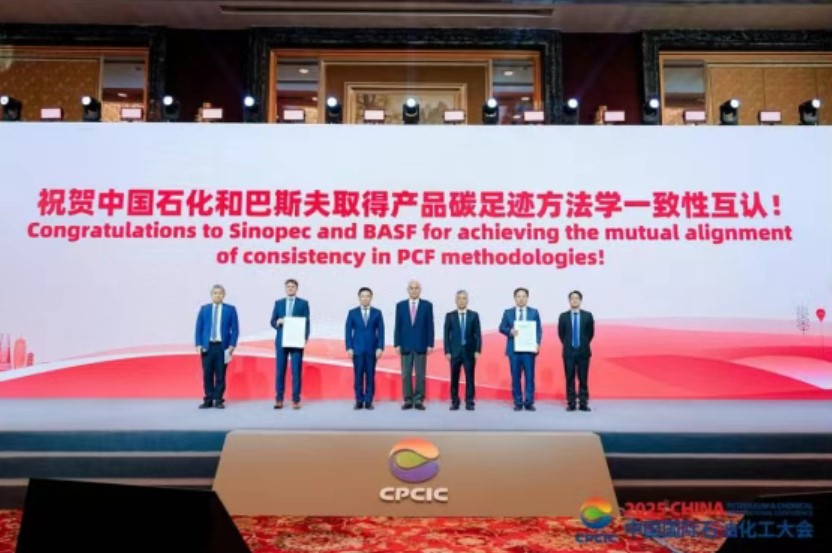
During the conference, Sinopec and BASF announced mutual recognition of product carbon footprint accounting methodologies, witnessed by the German certification body TÜV Rheinland. This sets a benchmark for international alignment of carbon footprint standards in the chemical industry, reduces verification costs, and promotes collaborative carbon reduction across the supply chain—marking a substantial breakthrough in Sino-foreign cooperation on carbon management.
In the "Peak Dialogue" moderated by Pang Guanglian, Executive Vice Secretary-General of the CPCIF, five leaders from multinational corporations and international organizations discussed how to stimulate new growth.
Julie A. McAlindon, Senior Vice President of Eastman, emphasized that sustainable development in the petrochemical industry depends on resilience across the entire value chain, including customer and supply chain resilience.
Li Kai, Vice President of Invista’s Asia-Pacific nylon upstream business, viewed the current industrial restructuring as a deeper form of "re-globalization", where innovation requires ecosystem collaboration, and China is playing an increasingly important role.
Sun Wenqing, Chairman of ExxonMobil Asia Pacific R&D, highlighted that China is fertile ground for high-quality development, where many new products, technologies, and solutions are developed and scaled.
Jacob Duer, President and CEO of the Alliance to End Plastic Waste, noted that China is the largest producer and consumer of plastics, leading in recycling investment and innovation, and expressed hope for deeper cooperation in "zero-waste cities".
Andrew Neale, Global Vice President of S&P Global for Chemicals, Derivatives, Plastics & Materials, acknowledged short-term challenges but emphasized that long-term trends like electrification and AI will continue to drive global chemical demand, with China showing strong innovation and investment appeal in energy transition and circular economy.
Marco Mensink, Director General of Cefic and Secretary General of the International Council of Chemical Associations, noted that Europe’s chemical industry faces challenges like high energy costs and declining competitiveness, but remains committed to green transformation. He called for a new industrial action plan to boost competitiveness and urged stronger China-Europe cooperation.
Machteld de Haan, Shell’s Global Executive Committee member and Chemicals Executive Vice President, and Dr. Ilham Kadri, CEO of Syensqo and Chair of ICIS, shared their views via video, emphasizing the importance of global cooperation, especially with China, in energy transition and technological innovation.
In his closing remarks, Pang Guanglian concluded that Europe’s experience in innovation-driven development, green transformation, and international cooperation offers valuable insights. Despite a bumpy global economic recovery, trends like energy transition, industrial restructuring, and green development are converging. The conference was not only a feast of ideas, but also a gathering of consensus and shared vision. As a pillar of the modern industrial system, the petrochemical industry is facing new challenges and opportunities. It is encouraging to see that governments, enterprises, and organizations—both in China and globally—are actively exploring a more open, collaborative, and sustainable path forward.
Source: CPCIC