Following Iran’s announcement on February 28 to completely close the Strait of Hormuz and its attacks on passing oil tankers, export logistics for crude oil and light hydrocarbons (ethane, LPG) from Persian Gulf nations (Saudi Arabia, UAE, Kuwait, Qatar, etc.) have been severed. Simultaneously, security alert levels in the region have reached their peak, forcing some facilities to shut down due to feedstock shortages or as a preventive safety measure. The affected units are primarily ethane crackers in the Middle East, along with some facilities in Asia (Singapore, South Korea, Japan) that rely on Middle Eastern feedstocks.
Middle East Region
Asia-Pacific Region
Qatar accounts for approximately 20% of global LNG supply, with about 82% of its customers located in Asia. The halt in Qatari LNG production, combined with expectations of naphtha supply disruptions from the Middle East, has led cracking units in Southeast Asia, South Korea, and India to gradually declare force majeure or reduce output.
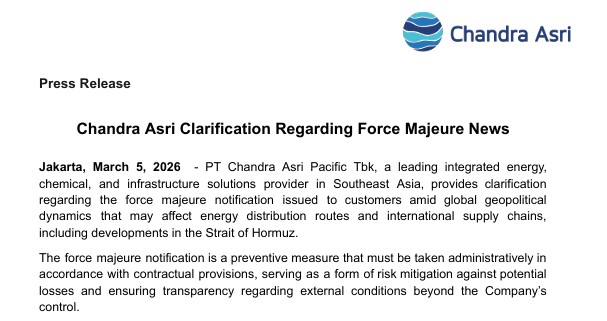
Chandra Asri (Southeast Asia - Indonesia) Declares Force Majeure:
On March 2, Chandra Asri stated in a customer letter that it had declared a force majeure event due to interruptions in the transportation and delivery of feedstock imported from the Middle East caused by the US-Iran conflict. Severe disruptions to maritime transport in and around the Strait of Hormuz have impacted the shipment and delivery of its raw materials. The letter did not specify the duration of the force majeure or explicitly identify which products would be affected. The company operates a 900,000-ton-per-year ethylene unit and a 490,000-ton-per-year propylene steam cracker.
Aster Chemicals (Southeast Asia - Singapore) Force Majeure Extended:
Aster Chemicals’ cracker on Pulau Bukom, Singapore, previously declared force majeure in August 2025 due to delayed maintenance. Now, impacted by soaring naphtha and LPG prices and supply instability resulting from the Middle East situation, its restart plan has been postponed again, extending the force majeure status.
MRPL (India):
Due to uncertainties regarding gasoline export shipments for March and April stemming from the Middle East conflict, the Indian state-owned refining enterprise Mangalore Refinery and Petrochemicals Ltd (MRPL) recently declared force majeure. In January, MRPL halted imports of Russian crude in compliance with Western sanctions and considered switching to Venezuelan oil. The company’s Karnataka refinery has a processing capacity of 500,000 barrels per day, with 40% of its refined product output destined for export.
YNCC (South Korea) Declares Force Majeure:
On March 4, due to disruptions in naphtha feedstock supplies from the Middle East, South Korean petrochemical giant YNCC declared force majeure, stating it would be forced to operate all production facilities at "minimum capacity." YNCC (Yeochun NCC), located in Yeosu, South Jeolla Province, is a major petrochemical enterprise jointly owned (50% each) by Hanwha Solutions and DL Chemical (formerly Daelim Industrial). YNCC operates three naphtha cracking units (steam crackers); Unit 2, with an ethylene capacity of 915,000 tons/year, was operating normally prior to this event. Leveraging feedstocks from these crackers, YNCC also possesses a benzene capacity of 457,000 tons/year, a styrene capacity of approximately 370,000 tons/year, and capacities for propylene and butadiene.
China’s Petrochemical Industry Dependence on Middle Eastern Crude Oil
In 2025, China’s total crude oil imports reached a record high of approximately 578 million tons. Of this, imports from the Middle East totaled about 300 million tons, accounting for roughly 52% of China’s annual crude oil import volume. Although Russia is China’s largest single source of imports, the Middle East as a whole (including Saudi Arabia, Iraq, UAE, Oman, Kuwait, and Iranian crude transshipped via Malaysia, etc.) remains China’s core supply region, contributing over half of its import volume. By country, imports from Saudi Arabia amounted to approximately 80.76 million tons (up 3.5% year-on-year), while imports from Iraq remained stable at about 64.62 million tons. Combined imports from the UAE, Oman, and Kuwait totaled around 91.88 million tons, with imports from the UAE showing significant growth. Additionally, actual imports from Iran, transshipped via locations like Malaysia, remain substantial.
Crude Oil Consumption by Specific Chemical Products
In 2025, China’s petroleum consumption structure showed clear divergence: consumption of transportation fuels (gasoline, diesel) peaked and began to decline, while chemical light oils (chemical feedstocks) continued to grow. Chemical feedstocks now account for 25%-28% of total petroleum consumption, becoming the core engine driving oil demand growth. In 2025, China’s apparent total petroleum consumption was approximately 762 million tons. Of this, crude oil and light hydrocarbons (including naphtha, LPG, ethane, etc.) used for producing chemical products amounted to roughly 190-200 million tons in crude oil equivalent, representing about 26% of domestic petroleum consumption.
Propylene and ethylene are two key upstream raw materials for polyurethanes. Their 2025 production, consumption, and feedstock routes in China are as follows:
Ethylene
Benzene and toluene are upstream raw materials for MDI and TDI, respectively, and both are by-products of naphtha cracking for ethylene production. In 2025, China’s apparent ethylene consumption ranged between 41.5 and 42.0 million tons, a year-on-year increase of approximately 3.5%-4%, driven by downstream demand from packaging and automotive lightweighting. China’s ethylene production in 2025 was about 39 million tons, with improved capacity utilization. The primary domestic ethylene feedstock routes are naphtha cracking and ethane cracking. Comprehensive estimates suggest that approximately 75-80% of ethylene production feedstock relies directly or indirectly on imported petroleum resources.
Benzene
Upstream sources of benzene primarily include petrochemical and coal chemical pathways.
Conclusion
The Middle East conflict has triggered significant volatility in recent international oil prices. Following the cascading logic of "Crude Oil → Ethylene → Benzene," if the closure of the Strait of Hormuz persists, leading to reduced Middle Eastern crude inputs into China, domestic oil cracking and benzene enterprises will face production cuts. This expectation is the primary factor driving the sharp price increases observed since the beginning of this week for domestic benzene, toluene, and their downstream isocyanate raw materials like MDI and TDI. Beyond the ethylene value chain, market prices for the propylene-propylene oxide-polyether polyol chain are also rising in tandem.